
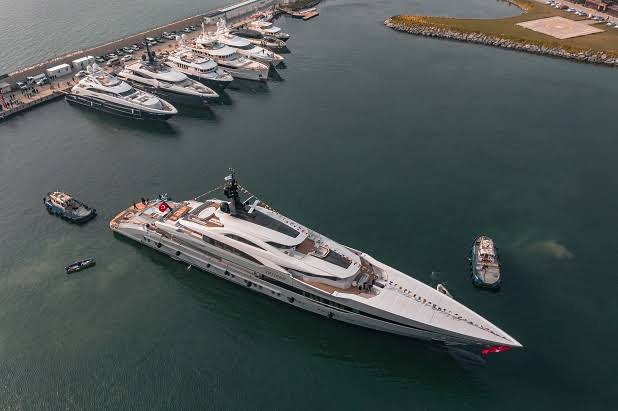
Turkey has climbed to second place among the world’s superyacht-building nations, trailing only Italy and now ahead of the Netherlands — a milestone confirmed in Türk Loydu’s 2024 Yacht Market Report and 2025 Yacht Industry Outlook, and echoed across the country’s shipbuilding sector. For a market that was widely cited as third-largest just a few years ago, the move to second is more than a ranking change. It’s a signal of where serious buyers should be looking.
A decade of quiet, steady climbing
Turkey’s rise hasn’t happened overnight. Shipyards clustered around Tuzla and Yalova near Istanbul, along with facilities in Bodrum and Antalya, have spent the last decade building a reputation for combining semi-custom and full-custom construction at a price point that undercuts Western European yards without cutting corners on engineering.
The numbers back up the trend. Turkish ship and yacht exports reached $1.912 billion in 2024 and climbed to an all-time high of $2.243 billion in 2025. The momentum has carried into 2026, with exports in the first four months of the year up 103.8% year-on-year. Industry projections point toward $3.5 billion in exports within two years, with a forecast compound annual growth rate of 13.7% through 2030.
The yard behind the headline: Turquoise Yachts and Angelique
If one delivery captures the moment, it’s ANGELIQUE, an 88-metre, 2,550 GT superyacht delivered by Turquoise Yachts in Pendik, Istanbul, in May 2026. It’s being described as the largest yacht ever built in Turkey — designed inside and out by H2 Yacht Design, with accommodation for 12 guests across seven cabins, a glass-fronted pool, and a wellness suite.
“ANGELIQUE unequivocally marks a new standard of our ability,” said Burak Akgül, CEO of Turquoise Yachts, at the delivery. It’s a fair summary of what the wider industry has been building toward: not just larger yachts, but yachts that compete on design and finish with anything coming out of Italy or the Netherlands.
Turquoise isn’t alone. Bilgin Yachts operates a 79,000 m² facility in Yalova and has more than a dozen projects in build at any given time, including the upcoming 86-metre Bilgin 282. Numarine’s Gebze facility runs Europe’s largest 5-axis CNC machine and delivers up to a dozen semi-custom yachts a year. Sirena Yachts, Mengi Yay, and Dünya Yachts round out a cluster of builders that, together, account for a production capacity approaching 700,000 GT — over 90% of which is exported.
What this means if you’re buying
For anyone shopping in the 25–50 metre range especially, the practical implications are straightforward:
Build slots are opening at competitive lead times. As Turkish yards scale capacity, buyers are finding shorter waits than at some long-booked Italian and Dutch yards.
Price-to-quality has shifted in the buyer’s favor. The same engineering and finish standards that once required a Western European price tag are increasingly available at a lower build cost, without the compromises buyers feared a decade ago.
Aftercare is local. With most major yards clustered around Istanbul’s Tuzla and Yalova districts, refit, warranty work, and ongoing maintenance sit close to where the yacht was built — a genuine advantage for owners who plan to keep their vessel in the Mediterranean.
Best Yachts Turkey’s view
We work directly with several of the yards driving this growth, and we’re seeing the shift reflected in buyer conversations: fewer questions about whether a Turkish-built yacht can compete, and more questions about which yard and which model fit a specific brief. If you’re considering a new build or evaluating a Turkish-built yacht already on the market, our team can walk you through current inventory, yard capacity, and realistic delivery timelines.